See → Understand → Act.
Live multi-modal signals → Executable world model → Safe robot action.
FactorySpace turns radio chatter, cameras, and machine signals into real-time operational intelligence that helps teams understand work, reduce downtime, and safely guide robots.
ERP sees orders. MES sees schedules. PLCs see machines. Cameras see pixels. FactorySpace understands work — what happened, what changed, who acted, and what should happen next.
Intelligence first. Execution next.
FactorySpace connects live workcell understanding to safe physical action — so factories can move from visibility to verified execution.
FactorySpace is not another dashboard. It is the intelligence and execution layer for real factory work.
Sees the work, understands live workcell state, remembers what happened each shift, and identifies the next safe action.
Checks constraints, approvals, and business rules before any action reaches a robot, PLC, machine, or operator workflow. Stores every action and outcome.
Carry out supervised physical tasks once the workcell is understood, verified, and safe to act on.
What the first production cell proves.
Start camera-first on one high-value workcell. FactorySpace proves whether live video can surface losses, verify steps, replay incidents, and identify the first supervised workflow — without replacing existing systems.
Waiting machines, empty trays, blocked workflows, missing operators, and missed cycles become visible for the first time — with timestamps and production loss estimates.
See exactly what happened before a delay, failure, or missed action. Every state, event, and outcome stored per shift and available on demand for diagnosis and audit.
Understand whether an issue came from the machine, robot, operator, part flow, or process sequence — without relying on manual observation or operator recall.
Factory Brain identifies whether the next action should go to an operator, robot, machine, or supervisor — aligned with live production goals and business intent.
Is your cell a fit?
FactorySpace is best for production cells where missed steps, manual verification, waiting time, operator shortage, or rework create measurable loss.
The cell runs a defined sequence of steps that can be observed, mapped, and verified from live video.
What happens in the cell is physically observable — parts, tools, boards, steps, and operator actions are visible on camera.
Missed steps, waiting time, rework, or manual verification burden create real, quantifiable production loss per shift.
There is a clear path from operator guidance to robot-assisted execution once the workflow is understood and verified.
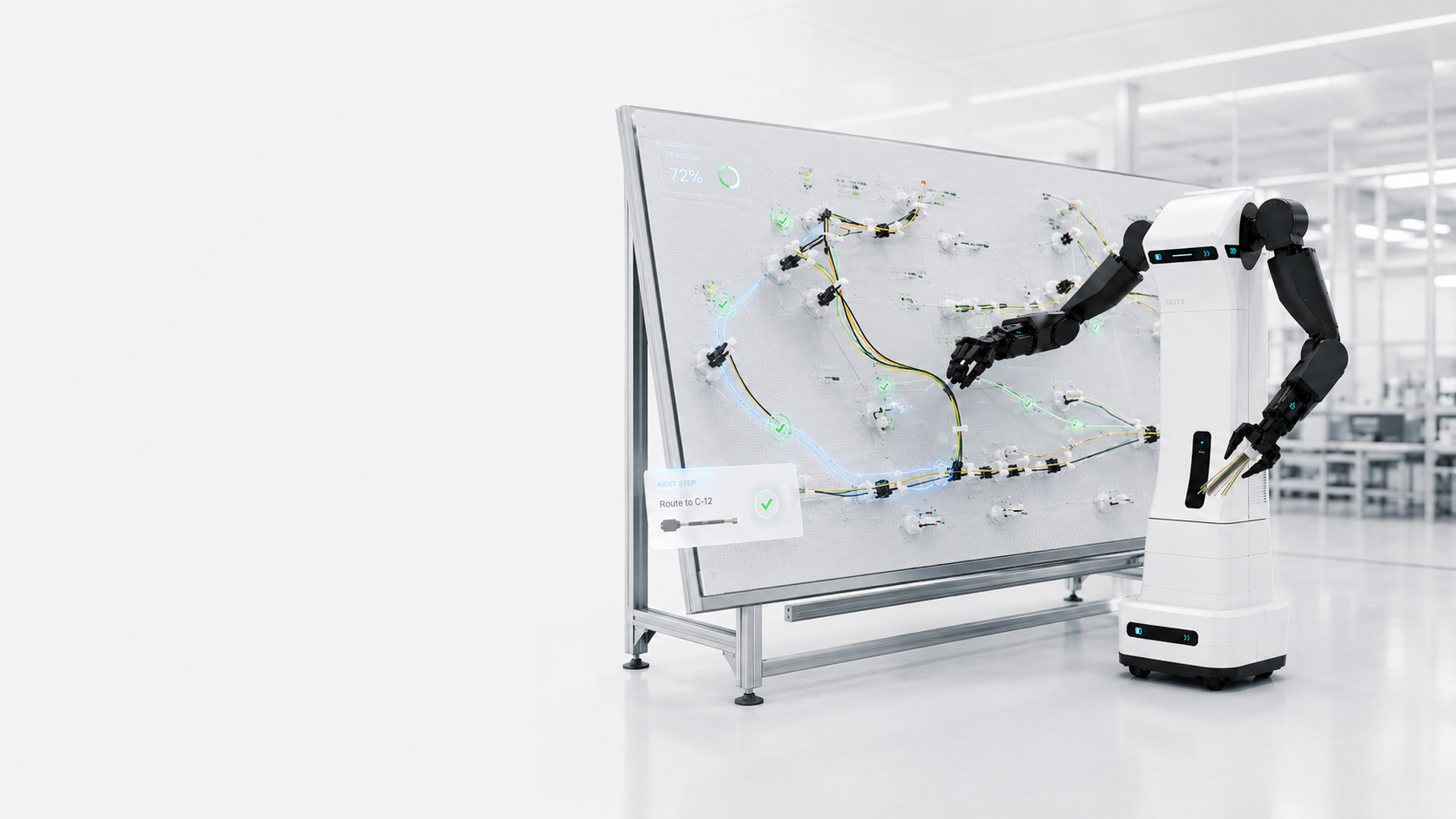
Wire harness assembly.
Analog formboards are manual, space-heavy, hard to change over, and difficult to verify in real time. Factory Brain watches the board, understands the route, guides the next step, verifies completion, and creates replayable shift memory.
Wire Harness Assembly
Where Factory Brain expands next.
Machines wait when operators miss cycle-complete. Factory Brain detects completion, identifies idle risk, and dispatches the next task to a robot or operator. Outcome: less machine idle time, fewer missed cycles.
Defects found late or inconsistently. Factory Brain watches checkpoints, flags missed or delayed steps, triggers image capture, and verifies pass/fail. Outcome: fewer missed defects, better traceability.
Failures repeat without a full state record. Factory Brain replays failures, debugs cycle delays, and verifies whether robot or dispenser actions completed correctly. Outcome: faster debugging, fewer repeat failures.
The product stack for verified factory action.
FactorySpace combines intelligence, execution, safety, memory, and connectors so companies can move AI from dashboards into supervised, verified physical action — starting with one production cell.
Builds live semantic workcell state from cameras and factory signals. Detects waiting, exceptions, and blockage. Generates the next safe action aligned with business intent.
Supervised execution workflows for machine tending, inspection, part handling, and material movement — under Factory Brain supervision with safety checks.
Deterministic safety checks before every action. Approvals, verification, and deployment controls. Full record of every state, action, and outcome per shift.
Designed to connect progressively with CNC controllers, PLCs, cameras, robots, sensors, ERP, MES, and operator workflows. Early deployments begin camera-first — deeper integrations activate where useful.
FactorySpace gives every production cell the context, memory, safety, and execution layer needed to apply AI safely inside real operations.
Machines, parts, trays, tools, operators, robots, and production goals represented as live factory state — continuously updated against incoming business orders.
State history, exceptions, robot actions, operator actions, and outcomes stored per shift — available for diagnosis, audit, and workflow improvement on demand.
Subgoals, constraints, approvals, and verification before and after every action — across robots, operators, PLCs, and automation systems.
Every action passes safety checks and business rule validation before reaching a robot, PLC, or machine. Not optional, not configurable out.
Built for the teams closest to the production cell.
FactorySpace is for manufacturers, system integrators, and technology partners who need AI to move from pilots into verified, supervised factory workflows.
FactorySpace starts camera-first on that cell, maps how work happens today, surfaces losses, verifies steps, and identifies the first supervised workflow — before committing to a large integration project.
Deploy Factory Brain alongside any robotic deployment. Customers get incident diagnosis, remote visibility, after-sales intelligence, and a clear upgrade path from one cell to fleet.
Connect your robot, sensor, or vision model to live workcell context, safety constraints, business priority, and verified workflows — so your product moves from demo to production deployment faster.
From live video to verified factory action.
Five steps. From bringing in available signals to confirming the action worked — with deterministic safety checks at every stage.
Add ERP, MES, PLC, robot, and sensor signals progressively as deployment expands and value is proven.
Machines, parts, trays, tools, robots, and operators mapped into a live semantic model against incoming business orders.
Detects waiting, exceptions, blockage, and constraints — then generates the next executable goal aligned with business priority.
A validated instruction routes to an operator, robot, PLC, or automation workflow — through deterministic safety and approval checks.
Confirms the desired state was reached and stores a replayable record of every action, detection, and outcome.
Start with one production cell.
FactorySpace works with selected design partners to map a real production cell, capture live context, replay incidents, and identify the first supervised workflow. Our engineers work directly with your plant, automation, and IT teams to configure and prove the first deployment.
Camera-first. Existing cameras or a simple camera kit. Live operations captured from day one. No PLC required to start.
Factory Brain maps machines, parts, trays, operators, robots, and cycle states into a live semantic model of the cell — against incoming business orders.
Waiting and idle-time visibility. Bottleneck and exception replay. Hidden losses made visible per shift.
Rank automation opportunities with estimated impact and fit — robot, sensor, integrator, or operator workflow — before committing to integration.
Recommended connections for ERP, MES, PLCs, robots, sensors, or operator apps — progressive, not all at once.
Proven deployment approach from one cell to additional workflows, cells, and sites — with the same product stack.
FactorySpace engineers work directly with your manufacturing, automation, and IT teams to map the first production cell, configure Factory Brain, connect available systems, and identify the highest-value supervised workflow.
The goal is a repeatable product deployment — not a one-off custom project.
- Live workcell context model
- Replayable event memory
- Waiting and exception visibility
- First supervised workflow candidate
- Integration roadmap for ERP, MES, PLCs, robots, sensors, or operator apps
- Deployment plan for repeatable rollout
For partners helping deploy the first intelligent workcells.
FactorySpace works with robots, sensors, vision systems, and integrators that need live workcell context, safety runtime, and verified execution inside real production environments.
Early partners can work with FactorySpace to define integration points for live workcell state, events, exceptions, and workflow actions — so your robot, model, or automation tool always knows what is happening and what to do next.
Every action from your product passes through deterministic safety checks, business rule validation, and post-action verification before reaching robots, PLCs, or machines. Designed for enterprise production environments.
Designed to connect progressively with CNC controllers, PLCs, cameras, robots, sensors, ERP, MES, and operator workflows. Camera-first on day one — deeper integrations activate where useful and where the customer is ready.
The wedge is one cell. The platform is every workcell.
Each deployment creates reusable workcell models, workflow templates, verification rules, action history, and integration patterns — so expansion across cells, lines, and sites reuses everything built in the first cell.
Does your cell fit?
We are selecting design partners with one high-value production cell where missed steps, manual verification, waiting time, operator shortage, or rework create measurable loss. Bring us one painful cell.
Apply as design partnerWe will start camera-first, map the workflow, surface losses, verify steps, and identify the first supervised workflow.